On Tuesday 6 October I had an empty evening and no plan for it, which usually means I lose it to my phone. Instead I walked to the public library in Olsztyn for a book talk about a village that is now, more or less, my neighbourhood.
I came home with a book thin enough to fit in a coat pocket. I am about a third of the way through it, reading it in small pieces, and it has turned into the most unexpected slow-living practice I have picked up this year: learning where I actually live.
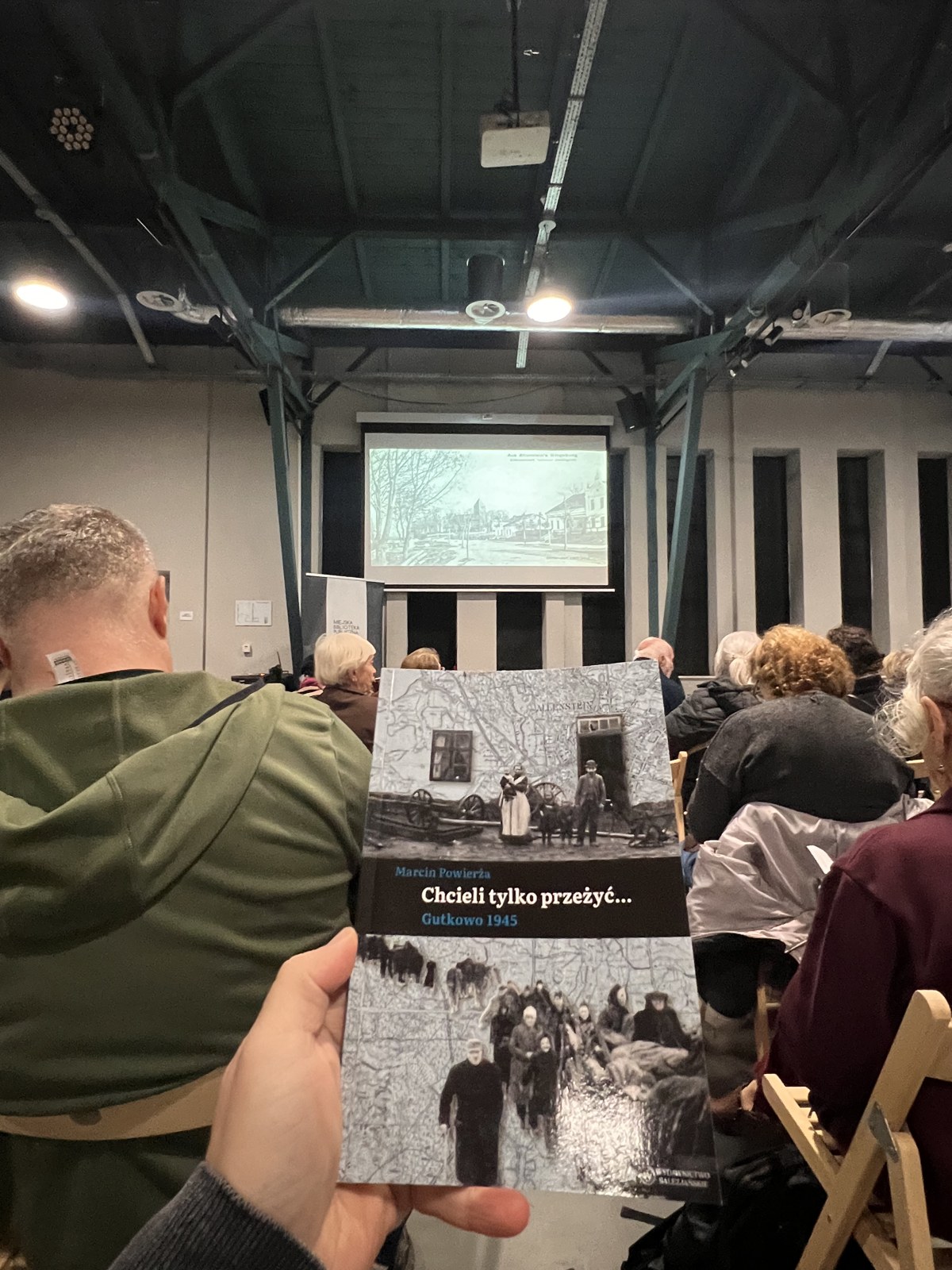
A thin book about Gutkowo
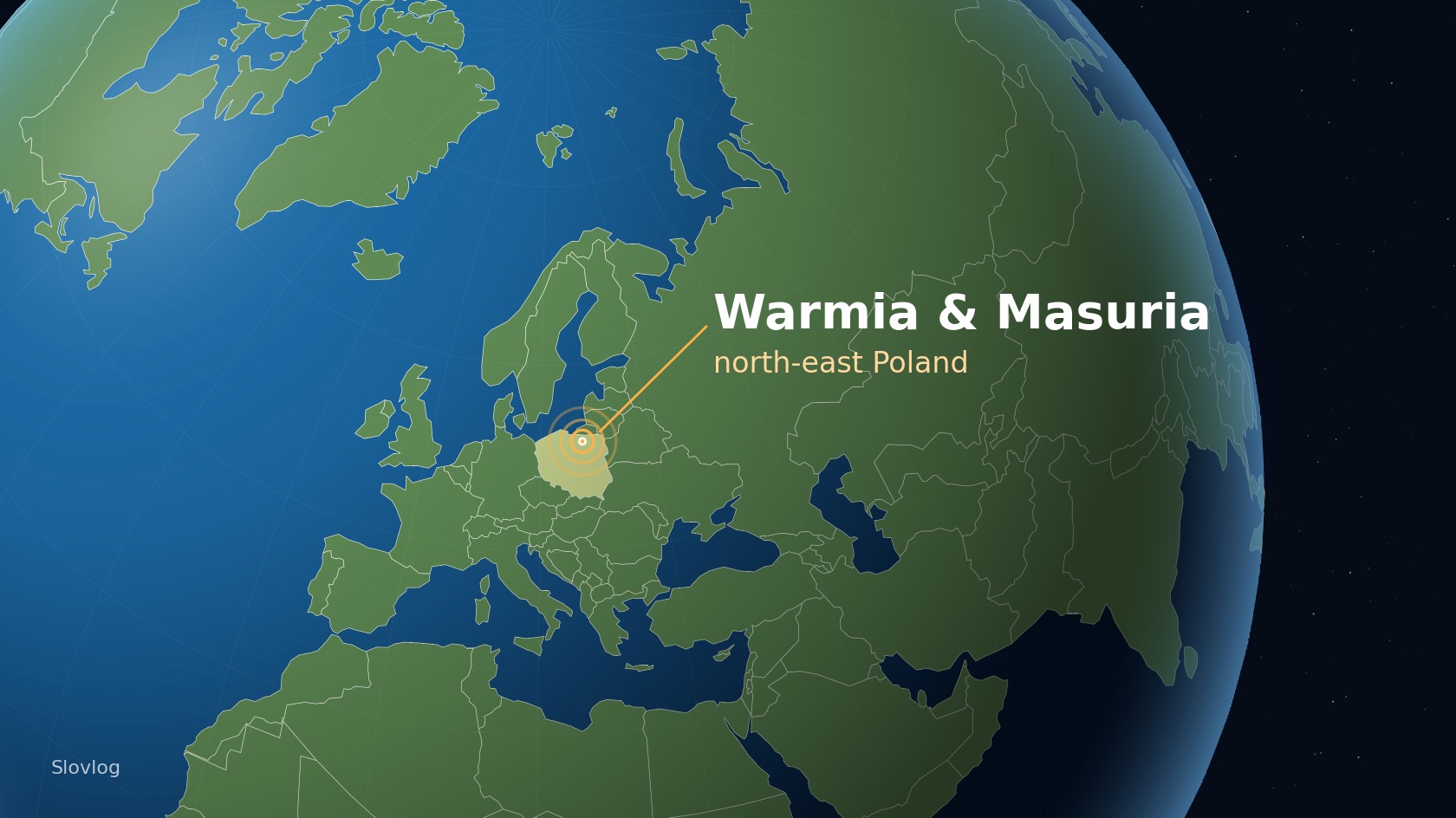
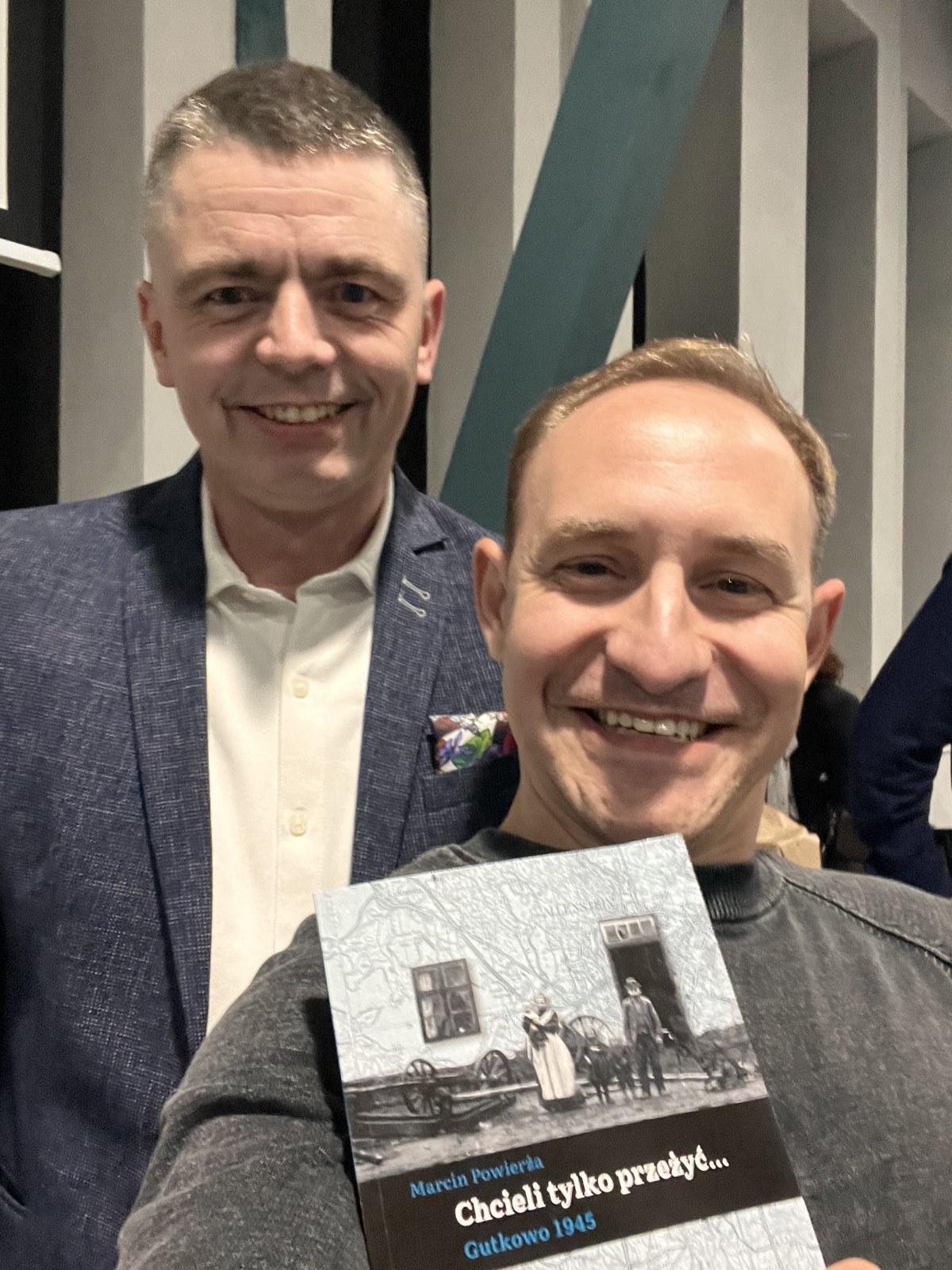
The book is Chcieli tylko przeżyć… Gutkowo 1945 — “They only wanted to survive” — by Marcin Powierża, a historian by training who has spent years collecting accounts from the former Gutkowo parish. That parish covered Gutkowo, Likusy, Redykajny and Łupstych: four names that today are districts and suburbs on the western and northern edge of Olsztyn, ringed by lakes, the kind of place where people walk dogs along the water at seven in the morning.
In January 1945 they were villages, and the Red Army was arriving.
The evening did not open with the book. It opened with an argument the city has been having for decades, about the concrete monument that everyone in Olsztyn calls the gallows. Should it carry an explanatory plaque, or come down altogether? The room did not agree, and I am not going to pretend I have the answer either.
What stayed with me was the small thing Powierża said next. One of the women whose memories are in the book used to walk past that monument with him in the late 1980s. Every single time, she turned her body away from it and walked several dozen steps without looking. He was young, he did not know why, and he did not ask. Years later, on a trip out to Kadyny, she finally told him what the soldiers had done in the flats of her street.
That is how most of this book was gathered. Not from an archive. From walks.
The Sunday the trucks never came
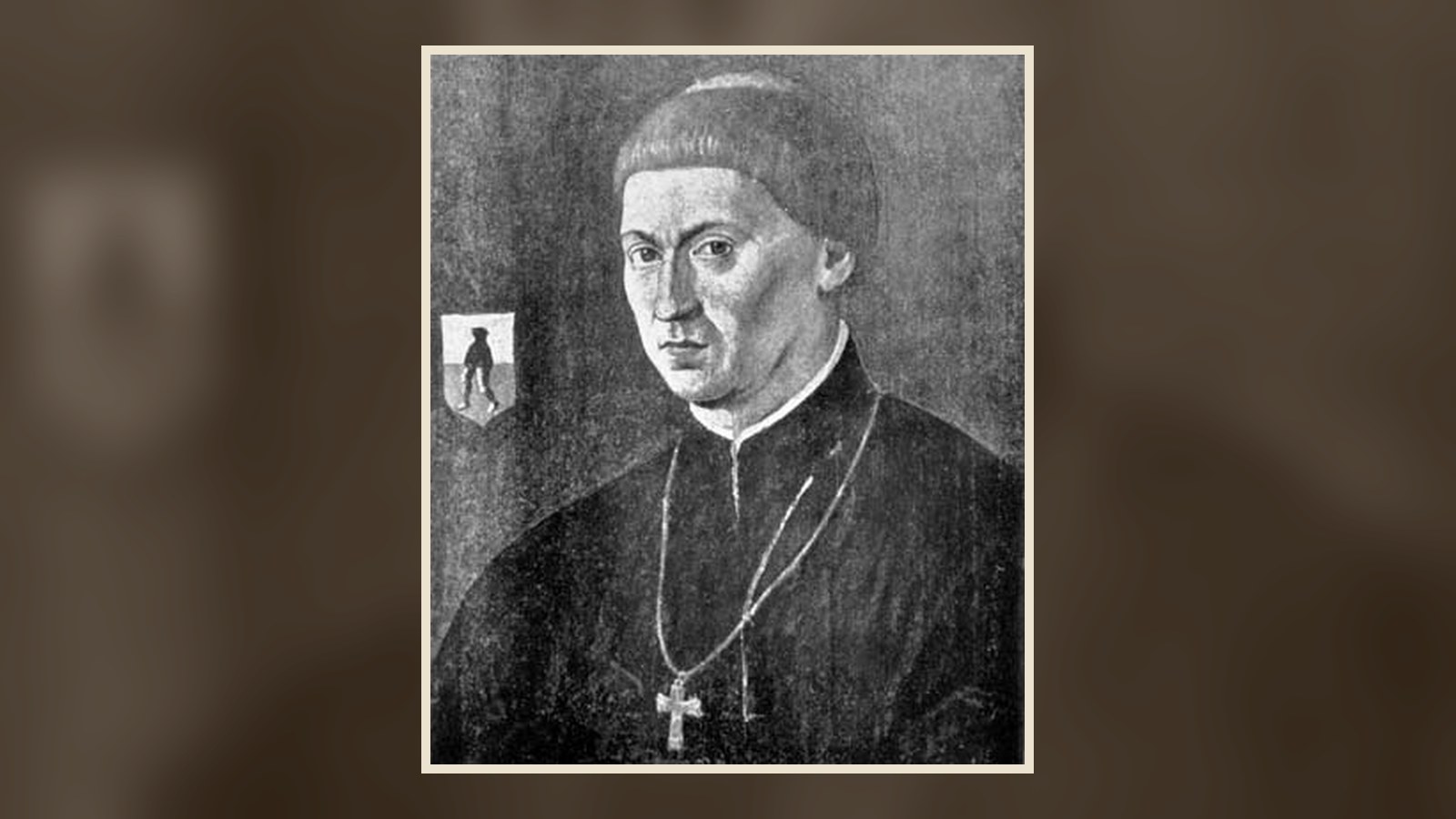
21 January 1945 was a Sunday. People from Gutkowo and the villages around it came to Mass, and instead of a sermon the parish priest, Hubert Krebs, read out the official German evacuation notice. Go home. Take only what you need. Gather at the Konrad department store, where lorries will come for you.
They stood with their bundles for hours. No lorries came. So they walked to the station at Gutkowo and climbed onto a freight train heading towards Morąg. What happened to those people, whether they arrived anywhere, nobody knows.
The ones who stayed asked the priest why he was not leaving. According to the accounts in the book, he said something like: why would I run? I am a Warmian, I am not a German. And most of the village answered: then we are Warmians too. If the priest stays, we stay.
Two days later, on 23 January, the soldiers came through.
There is one detail from those weeks I keep turning over. People left their front doors unlocked. Two reasons, both of them practical. First, so that refugees coming from further east could get inside and warm up. Second, because a locked door meant more damage when the soldiers reached it. In the coldest January anyone could remember — minus thirty at night, and minus twenty in the daytime counted as mild — an unlocked door was the sensible choice.
One family in the book got as far as Jonkowo before their lorry broke down, and spent several weeks in a farmer's house. The father walked the few kilometres back to see about their own home, found the roof wrecked, and decided there was no fixing it until spring. So they waited for the weather. That is the whole plan: wait for it to get warm, mend the roof, go home.
Jadwiga, twenty. Elżbieta, twenty-two.
The part of the evening that went quiet was about livestock.
Cattle and horses taken from farms across the region were collected at Redykajny, and someone had to feed and milk them. So between six and eight thousand local people were pressed into the work, and then put on trains east.
Among them were two sisters from a farm on the edge of Gutkowo and Redykajny. Jadwiga was twenty. Elżbieta was twenty-two. In April 1945 they were loaded into cattle wagons along with the animals and travelled roughly two and a half thousand kilometres, ending up at the foot of the Urals. Both of them died of exhaustion and illness in July and August of the same year. Neither lasted six months.
Powierża found the second sister almost by accident. The German Red Cross had a record of only one. He went looking, and the archive gave him the other name.
Their priest noted in his parish books that by 1948 a letter had reached him from a woman who had been there and seen both deaths. Their parents were told. According to the relative who lent Powierża the family photographs, they never believed it, and waited for their daughters for the rest of their lives.
The four savings books
Near the end, the moderator asked him to show the room something that is not in the book at all.
He put four small passbooks on the table. Deutsches Sparkassenbuch, issued by the Stadt- und Kreissparkasse Allenstein — the municipal and district savings bank of Olsztyn, back when the city was called Allenstein — with the outline of the Olsztyn castle printed at the bottom of each cover.
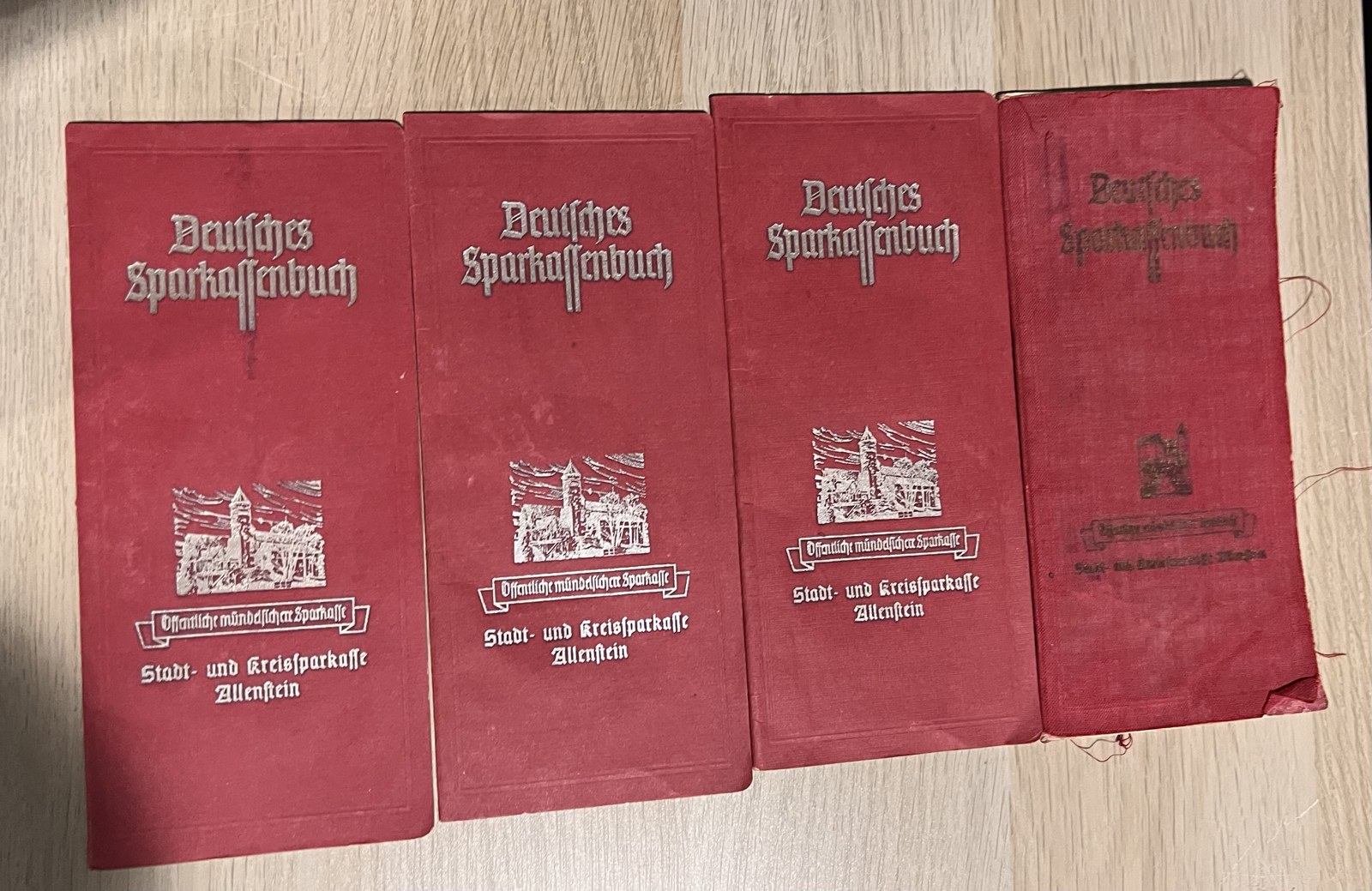
They are children's accounts. One per child. And the entries show the parents putting money in every single month, through the whole war, right up to October 1944 — by which point the front was already at the border of East Prussia and anyone paying attention knew what was coming.
One of the four books has no deposits. The child it was opened for was at the front.
A family that was quietly paying into a future they had no good reason to believe in. Powierża was given the passbooks by the family. He told the room what they said when they handed them over: take them, with you they will not lose their value.
The woman who stood up at the end
Then the evening did the thing that only happens in rooms.
The moderator was wrapping up, thanking everyone, pointing people towards the signing table. A woman stood up near the back and said she did not have a question, she just wanted to say something. She told us she was eighty-five.
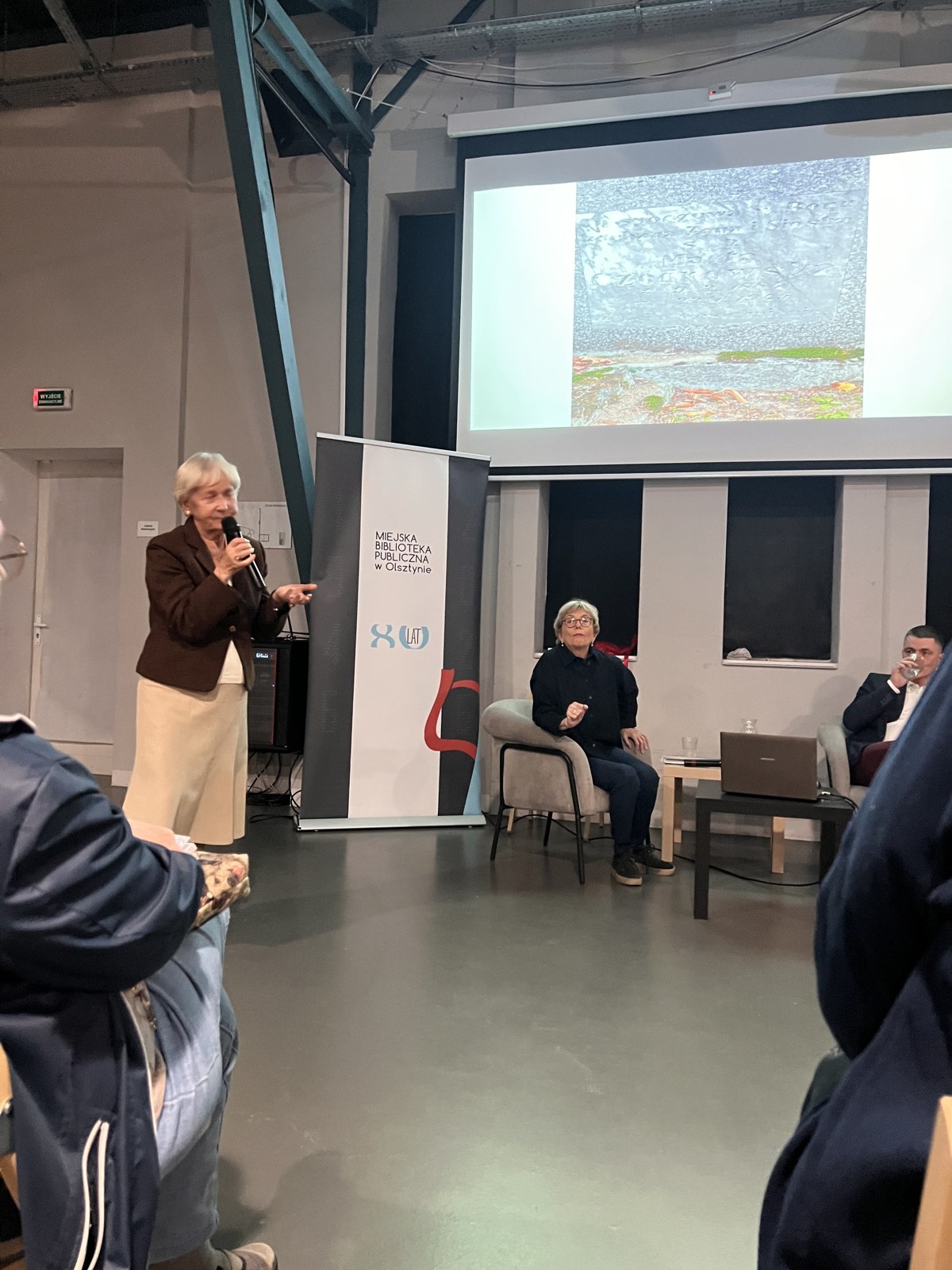
She was not quite five in 1945, in a different town, in a cellar. She said that she still cannot stand the sound of gunfire — that she puts her fingers in her ears at a cemetery salute, and that for years she did it when someone opened a bottle of champagne. Eighty years, and the body still files the sound in the same drawer.
And then the detail I have not been able to shake. Soldiers smashed her father's beehives. He cried like a child. Of everything she could have chosen to tell a room full of strangers, she chose the bees.
Nobody filmed it. There is no clip. You had to be in the chair.
Why I count this as slow living
Here is the honest version of how close I came to missing it.
My calendar was empty that evening. Nothing was booked, nothing was due. And I still almost stayed in, because an empty calendar is not the same thing as free attention — by seven in the evening mine is usually already spent, in twenty-minute pieces, on nothing I could name the next morning. The evening was free, local, forty minutes of my life round trip, and I nearly traded it for a feed. If you recognise that, the free Attention Leak Audit I put together is three days of tracking where your attention actually goes, which is the only way I ever found out.
Slow living gets photographed as lakes and coffee and wool socks, and I write about those too, because I live here. But the part that has changed more for me is less photogenic: staying somewhere long enough that the place starts to have depth. Street names stop being directions. A bus stop becomes a spot where something happened. It is the difference between living in a landscape and living in a place, and the only way through it is time.
I bought the book and he signed it. That felt like the correct exchange for the evening: a man spends years knocking on doors in four villages, and the asking price is less than a lunch out.
Twelve pages a night
The book is small. I could finish it in one sitting on a Sunday afternoon, and that is exactly what I am not doing.
I read about twelve pages in the evening and then stop, usually mid-chapter, because each of these accounts belongs to one person who had to decide to tell it. Reading four of them back to back turns them into content. Reading one and then closing the book leaves room for it to land.
This is the thing nobody tells you about short books: they are the easiest place to practise reading slowly, because there is no pressure of a spine still half unread. A thin book does not need to be defeated. It needs to be let in. I put this on my list of what slow living actually looks like alongside thirty other unglamorous, real things, and of all of them it has been the cheapest to start.
How to do this where you live
None of this is specific to Warmia. Every place has a version of it, and the entry points are mostly free.
- Check your public library's events page once a month. Not the museum, not the tourist office — the library. In Olsztyn the Municipal Public Library runs talks like this one quietly, for nothing, to rooms of thirty people.
- Find out what your street or village was called before. Most places in this part of Europe have at least two names and usually three. The older name is a thread, and pulling it takes about ten minutes.
- Walk to one place in the book. Reading that something happened at a particular bend in the road does very little. Standing at the bend does something else entirely.
- Ask the oldest person on your street one question, and then stop talking. Powierża's whole book is built on this. The answers are not usually in the first conversation. They came on the fifth walk, on the way back from somewhere else.
- Buy the local book instead of the national bestseller. Self-published regional history is rarely well designed and almost always better sourced than it looks. It is also the only way these books get written at all.
I have about a hundred pages left. It is the slowest hundred pages I have read in years, and I am in no hurry at all — which is roughly the whole idea, and more or less what I mean when I write about what slow living actually is. If you are reading this while planning your own move to somewhere like this corner of Masuria, my Discover Slow Living escape plan is written for exactly that stage, and this evening was a decent argument for choosing the place carefully rather than quickly. And if you would rather just come and look at the place first, the quiet corners of Poland is where I would start.
Frequently asked questions
What is the book Chcieli tylko przeżyć… Gutkowo 1945 about?
It is a collection of eyewitness accounts from the former Gutkowo parish near Olsztyn — Gutkowo, Likusy, Redykajny and Łupstych — describing the first weeks of 1945, when the Red Army entered Warmia. The author, Marcin Powierża, gathered the accounts from residents over several years.
Who is Marcin Powierża?
Marcin Powierża is a local historian from the Olsztyn area, a historian by training, who documents the wartime and immediate post-war history of the villages around the city. His work is built mainly on first-hand accounts from residents, supported by parish records and archive photographs.
Where was the book talk held?
At the Municipal Public Library in Olsztyn, on Tuesday 6 October 2026. Events like this are free, usually announced only on the library's own site and social pages, and attended by thirty or forty people.
What does local history have to do with slow living?
Slow living is largely about attention and attachment to a place rather than a slower schedule. Learning the history of the streets you walk daily deepens that attachment, costs almost nothing, and cannot be rushed — which makes it a near-perfect slow practice.
How do I find local history events where I live?
Start with your public library rather than a tourist office or museum. Libraries host author talks, local history evenings and archive screenings, publish them on their own websites, and charge nothing. Checking the events page once a month is enough to catch most of them.
Is the book available in English?
No. It is published in Polish only, like most self-published regional history in this part of Europe. If you do not read Polish, the practical equivalent is finding the equivalent local book where you live — almost every region has one, written by someone exactly like this.
Why read a short book slowly?
Because pace changes what you keep. Reading several first-hand accounts in one sitting flattens them into material; reading one and then closing the book leaves space for it to land. A thin book is the easiest place to practise this, since nothing about it feels unfinished.