Can You Practise Slow Living in a City?
Yes. Slow living is about rhythm and intention, not your address, so you can live slowly in the middle of a busy city. It comes down to designing small unhurried pockets into an urban day: protected mornings, real meals, third places, micro-doses of nature and firm digital boundaries.
This is the objection I hear more than any other. "Slow living sounds lovely, but I live in a flat in the city, so it's not for me." I understand the instinct. Every photo of the slow life seems to feature a meadow. But the meadow is set dressing. The actual substance travels anywhere, and I can prove it, because I lived it in a city long before I lived it by a lake.
Why People Think Slow Living Needs the Countryside
The confusion is understandable, and it's mostly the fault of marketing. Slow living got an aesthetic somewhere along the way: rural, rustic, soft linen, a wood-burning stove. That look sells, so it spread, and it quietly convinced a lot of city dwellers that the door was closed to them.
But the countryside is just one stage set for a deeper practice. The forest doesn't make you present. The cottage doesn't give you rhythm. Plenty of people move to a village and bring their frantic minds with them, then wonder why the magic didn't take. The pace lives in how you structure your attention, and you can structure it on the fourth floor of an apartment block as well as anywhere. The roots of the idea, which I cover in what slow living is, were never about geography.
Seven Ways to Practise Slow Living in a City
1. Reclaim your commute
The urban commute is dead time for most people, spent scrolling or stewing. Turn it into a buffer instead. Walk part of it if you can. Leave the headphones out one day a week and just notice the city. Read a real book on the train. The commute is a built-in transition the countryside doesn't even have, so use it.
2. Make one meal slow
You can't cook every meal from scratch with a city schedule, and you don't need to. Pick one. A proper breakfast at the table, or dinner with the phone in another room. Slow food in a city is about attention more than provenance. Even a quick meal eaten with full presence beats an elaborate one eaten over a screen.
3. Find your third places
Cities are full of "third places," the spots that are neither home nor work: a particular café, a library, a park bench, a corner of a bookshop. Adopt two or three. Become a regular. This is where urban slow living quietly beats rural life, because the village can't offer the same density of small, public sanctuaries within a short walk.
4. Take micro-doses of nature
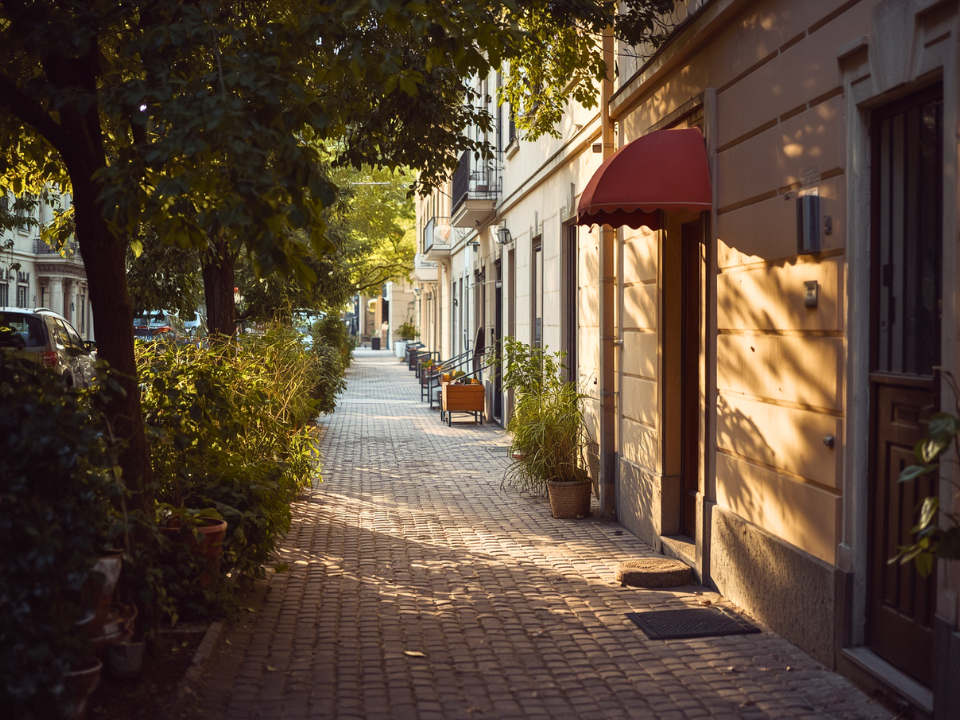
You don't need a forest. You need green, regularly and in small amounts. A street with trees, a city park, a single well-kept plant on your windowsill that you actually look at. The research on even brief contact with nature is encouraging, and cities hold more of it than we notice when we're rushing past.
5. Protect your weekends from the optimisation trap
City life has a particular disease: the weekend stuffed with so much leisure it needs its own recovery. Leave gaps. Schedule one thing on a Saturday, not five. Let an afternoon stay empty and see what wants to fill it. Unplanned time is where rest actually lives.
6. Build firm digital boundaries
The city never stops signalling, and your phone amplifies every signal. So the boundaries matter more here, not less. A screen-free first hour, a screen-free table, a screen-free hour before sleep. These are the walls that keep the urban noise from flooding every room of your day. If this is your weak spot, the benefits of a digital detox are worth reading.
7. Put down roots in your neighbourhood
Anonymity is the real enemy of slow living in a city, not density. So fight it. Learn the name of the person at your local shop. Use the same baker. Greet the same faces on your street. A neighbourhood you know turns a vast, indifferent city into something closer to a village, and that sense of being known is half of what people move to the countryside chasing.
Building Slow Rhythms Into a Fast Place
If you take one idea from all seven, take this: in a city you have to design your slowness, because the environment won't hand it to you. The countryside has a built-in tempo, dark evenings, quiet, the seasons in your face. The city has none of that. It runs at full speed by default and will keep you there unless you build the brakes yourself.
So build them. Pick two or three of the practices above and make them fixed points in your week, as reliable as your alarm. The structure is what creates the calm. Left to chance, the city always wins. Given a frame, it can hold a slow life surprisingly well. For a step-by-step start, see how to start slow living.
The City Years I Don't Talk About Much
People know me as the slow-living guy by the Masurian lakes, so they assume the lakes came first. They didn't. Before Warmia, I lived in Warsaw, in a flat close enough to a tram line that I learned its timetable by sound.
And I practised slow living there, badly at first, then better. A screen-free first coffee. A regular café where the owner knew my order. A long walk along the Vistula on Sundays with no destination. Those small, deliberate pockets kept me sane through some hard, fast years, and they were what eventually gave me the clarity to choose the move to Warmia at all. So when someone tells me slow living only works in the countryside, I think of that Warsaw flat. The lake didn't teach me to slow down. The city did. The lake just gave me more room to do it.
When City Slow Living Isn't Enough
Honesty matters here. For some people, after a while, the city does start to feel like the wrong fit, and no number of slow mornings fully fixes it. That's allowed. If you reach that point, it's worth taking seriously, and I've written about what a real move toward slower living looks like versus the glossy fantasy of it, and the practical side of it in my countryside move experiment. But please don't start there. Start by building a slow life where you are. Most people find that's enough, and the ones who do eventually move do it from a place of calm rather than desperation. Which is a far better way to make a big decision.
Frequently Asked Questions
Can you live slowly in a big city?
Yes. Slow living depends on rhythm and intention rather than location, so it works in any city. The method is to design unhurried pockets into your day, such as a screen-free morning, one slow meal, regular green space and a neighbourhood you actually know, since a busy environment won't provide them automatically.
Do I have to move to the countryside to live slowly?
No. Moving is one option, not a requirement. Many people build deeply slow, intentional lives in dense cities, and some who move discover their frantic habits travelled with them. It's wiser to establish a slow life where you are first, then decide whether a move would genuinely add to it.
Isn't a city too noisy and fast for slow living?
A city is faster by default, which is exactly why the practices matter more there. The noise and speed are the conditions you're working with, not a disqualification. With firm digital boundaries and a few protected routines, you can carve real calm out of a fast place, and cities offer perks the countryside lacks, like walkable third places.
What's the single best place to start in a city?
Your morning. A screen-free first hour at home is the most reliable foothold, because it's fully within your control and sets the tempo before the city's noise reaches you. Once that's steady, add a slow meal or a regular walk.
A Last Thought From Slovlog
The meadow is optional. What slow living actually asks for is a decision, repeated daily, to move through your life with intention instead of letting the place you live set the pace for you. You can make that decision tomorrow morning, in any postcode, with the life you already have.
If you want a gentle first step, my free Attention Leak Audit shows where your attention leaks in a normal city day. If you want a longer, guided path, Discover Slow Living: Your Escape Plan is a 50-page workbook of exercises and experiments that works just as well in a flat as in a lakeside cottage.