The Art of Displaying Beautiful Things: A Museum Visit in Warmia, Poland
There is a particular kind of quiet that exists inside old museums. Not silence exactly — more like a held breath. The sound of footsteps on stone floors. The faint creak of a wooden display case. The feeling that the objects behind the glass are waiting for someone to pay attention to them again.
I felt that quiet the moment I walked into the newest exhibition at the Museum of Warmia and Masuria in Olsztyn. The exhibition is called Skarby z serwantki — Treasures from the Display Cabinet — and it opened on February 27th. Curated by Ania Malinowska, it is built around a single piece of furniture and everything that piece of furniture reveals about the human need to surround ourselves with beauty.
I went because of the museum's podcast, Muzeoteka, hosted by Krzysztof Buzderewicz. Episode 8 covers the exhibition in detail, and after listening I could not stop thinking about it. The serwantka — I had one in my grandparents' home. Most people our age did. Hearing someone talk about it seriously, as a cultural object worth examining, felt unexpectedly moving.

What Is a Display Cabinet, and Why Did It Matter?
A serwantka is a freestanding glass cabinet, glazed on three sides, often with a mirror at the back to reflect light and create the illusion of depth. It was designed for one purpose: to display the things a household loved most while protecting them from dust and damage. Silver, porcelain, delicate glass, souvenirs brought back from travels. The objects you did not use every day but wanted seen.
The genius of this cabinet is that it made the private public. Guests could admire without touching. The family could signal taste, history, and aspiration through a single piece of furniture. As colonial-era travel expanded and people began accumulating objects from distant places, the display cabinet became a kind of personal museum — a curated record of a life's journeys and attachments.
The cabinet first appeared in the 18th century. By the 19th century it had become essential in bourgeois homes across Europe, reaching its peak during the Biedermeier period in German-speaking countries — an era when domesticity moved to the center of cultural life and people surrounded themselves with trinkets, mementos, and small beautiful things. The serwantka was the natural container for all of it.
A Walk Through 200 Years of Style
The exhibition traces the cabinet's evolution through changing design periods, and walking through it feels like a gentle education in how European taste shifted over two centuries.
The earliest pieces lean into Rococo extravagance — wavy gilded forms, curved legs, ornamental excess. Then Classicism arrives and strips everything back: harmonious proportions, restrained decoration, the confidence of simplicity. By the mid-19th century Biedermeier takes over, with its light birch and poplar veneers and its deeply human focus on the home as a sanctuary.
The Art Nouveau section stopped me longest. Dense metalwork covered in botanical motifs — flowers and vines climbing every surface. In a period obsessed with the idea that art should touch every corner of daily life, even a teaspoon became an argument for beauty.
The Meissen Teapot and the Snowball Pattern
Among the absolute highlights of the exhibition is an 1870s teapot from the Royal Porcelain Manufactory in Meissen. The design is from the 18th century — the famous Schneeball pattern, named for the snowball-like spheres formed by clusters of guelder-rose flowers modeled in three dimensions on the porcelain surface.
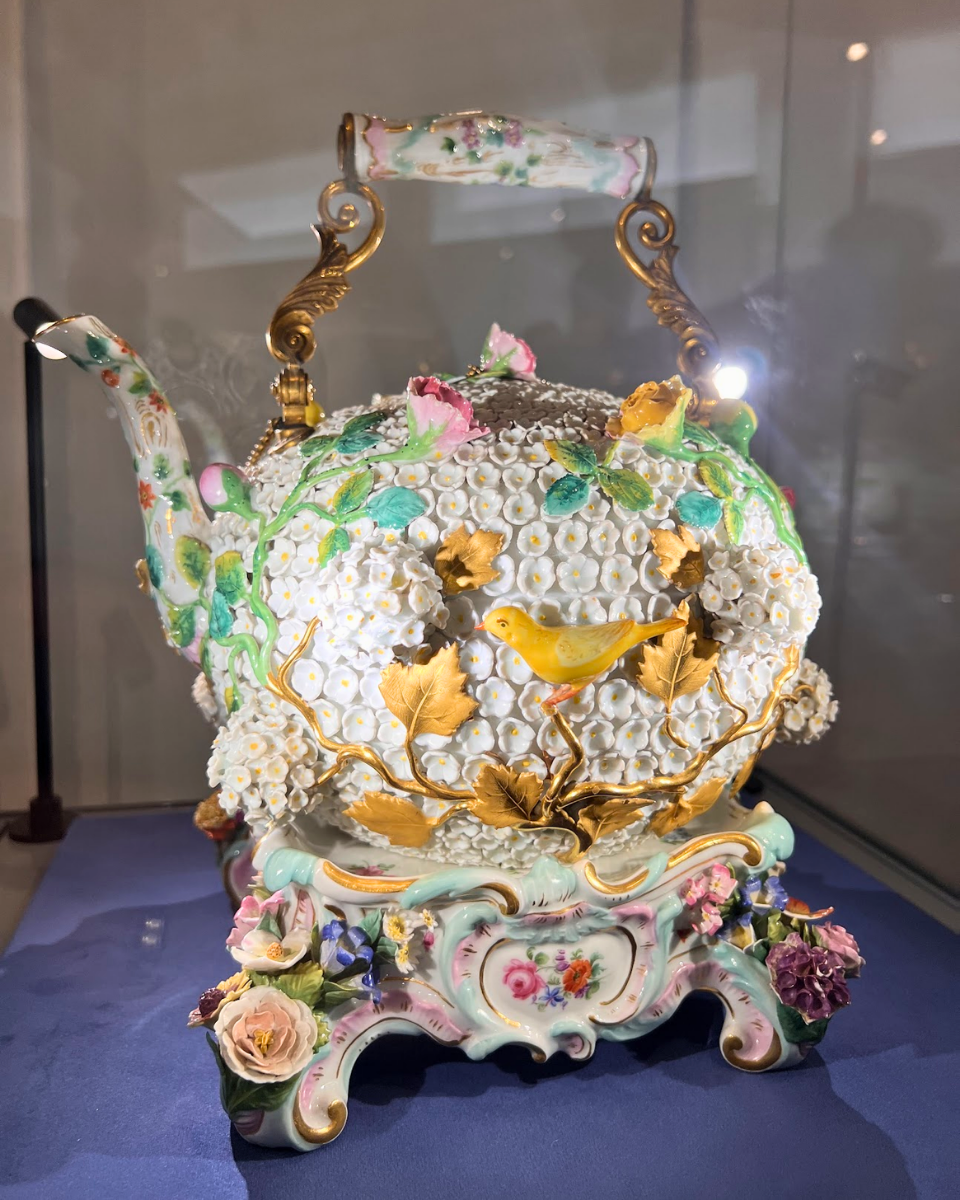
The history behind this pattern is quietly romantic. It was originally commissioned by King Augustus II as a gift for his wife, Maria Josepha. What began as a private gesture became one of Meissen's most iconic and enduring designs — still produced today, nearly three centuries later. Standing in front of it, knowing that story, the teapot shifts from decorative object to something more. A record of affection that outlasted everyone involved.
Nearby, the exhibition explains the so-called onion pattern — wzór cebulowy — which has nothing to do with onions. The name comes from a misidentification of the pomegranates depicted in the original Chinese designs that European craftspeople were imitating. Hydrangeas, pomegranates, blue and white glaze. Europe's long fascination with Eastern aesthetics, made permanent in porcelain.
The Social Ritual of Tea, Punch, and a Penguin-Shaped Pitcher
The exhibition does not stop at the objects themselves. It traces the social rituals that gave them meaning.
Tea drinking, spread by the expansion of the British Empire, became a ceremony in 19th-century European households. The museum's collection includes specialized teaspoons, ornate sugar tongs, delicate strainers — every object designed to slow down the act of pouring and drinking, to make it worthy of attention. The aesthetics of the service mattered as much as the tea itself. Beauty was part of the experience.
Then there is the penguin. A cold drink pitcher produced by the Włocławek Faience Factory, shaped exactly like a penguin, its painted decoration mimicking the bird's natural plumage. I stood in front of it for longer than I expected. There is something about a penguin pitcher that cuts through two centuries of cultural history and arrives at something purely human — the impulse to make a useful object delightful.
Nearby, large bowls designed for kruszon — a 19th-century drink made from wine, macerated fruit, and soda water, served over crushed ice. Even the name comes from the method: poured over crushed. A warm-weather ritual, now mostly forgotten.
The Wall Unit Room: A Wave of Memory
The second room of the exhibition is where things got personal.
In post-war Poland, the display cabinet disappeared. People moved into small concrete block apartments where every centimeter counted. The elegant freestanding cabinet was replaced by the meblościanka — the wall unit. Modular, space-efficient, glass-fronted shelves that served the same fundamental purpose: a place to display the things you loved.
The museum has recreated one of these rooms with care. Walking into it, the wave of recognition was immediate. My grandparents had exactly this. Crystal glassware on lace doilies. Decorative coffee sets displayed as status symbols even during periods when actual coffee was rationed. The objects on those shelves were a form of dignity — a way of saying: our home has beauty in it, even when everything outside is difficult.
The colored glass of the era, designed by artists like Zbigniew Horbowy, stands out in the display. Vibrant ambers, greens, and blues against the often gray reality of communist-era Poland. Several pieces belong to private collections, including items loaned by the curator herself. The exhibition makes no strict boundary between institutional history and personal memory. That felt right.
The 1930s Moderno coffee set, produced at the Włocławek Faience Factory, closes the exhibition. Its striking painted decoration carries the whole spirit of the show — which is why it was chosen as the visual identity for the exhibition's promotional posters. Bold, domestic, proud of itself.
About the Museum of Warmia and Masuria
The Museum of Warmia and Masuria sits inside the oldest building in Olsztyn — a 14th-century Gothic castle originally built by the Teutonic Chapter. Nicolaus Copernicus lived and worked here between 1516 and 1521, and on the cloister wall he drew an astronomical table still visible today — the only surviving instrument made and used by the astronomer himself. The museum holds his medical incunabula with handwritten notes, alongside collections of Gothic sculpture, religious paintings, Dutch portraits, folk culture, and contemporary graphics. Seven hundred years of regional history, held in one castle on a hill above the river.
If the Copernicus part caught your attention, the story carries on in Frombork, where he spent most of his working life, and in the life of the bishop who raised him.
Why I Keep Coming Back to Places Like This
I have been thinking about why this exhibition stayed with me as long as it did.
Slow living, at its core, is a practice of attention. Noticing what is in front of you. Choosing carefully what you keep and what you let go. The people who arranged their display cabinets were doing exactly that — curating the objects that represented who they were and what they valued, and putting them somewhere visible, where they could be seen every day.
There is nothing nostalgic about that impulse. It is completely current. The question of what to keep, what to display, what deserves a place in your daily life — that is the same question whether you are a 19th-century household arranging porcelain or someone in 2026 deciding what belongs on a shelf. If that question is alive for you right now, my piece on decluttering your life and mind is a gentle place to start.
The objects change. The need does not.
The exhibition is open at the Museum of Warmia and Masuria in Olsztyn. If you are in the region, it is worth an afternoon. Go slowly. The objects behind the glass have been waiting a long time to be looked at properly.
If you are putting a longer trip together, the museum sits inside a region I have written about at length — the quieter side of Poland, beyond the tourist trail.
Frequently asked questions
What is a serwantka?
A serwantka is a freestanding glass cabinet, glazed on three sides and often backed with a mirror. It was made to display the things a household loved most, such as silver, porcelain, glass and souvenirs, while keeping them safe from dust.
What is the Skarby z serwantki exhibition about?
Skarby z serwantki, or Treasures from the Display Cabinet, follows one piece of furniture through roughly two centuries of style, from Rococo and Classicism to Biedermeier and Art Nouveau. It also looks at the rituals around it, like tea and punch, and ends with the post-war wall unit.
Where is the exhibition?
It is at the Museum of Warmia and Masuria in Olsztyn, inside the 14th-century Gothic castle. It opened on 27 February and was curated by Ania Malinowska.
What is a meblościanka?
The meblościanka is the modular wall unit that replaced the freestanding cabinet in small post-war apartments. It had glass-fronted shelves and served the same purpose: a place to display the things you loved.
What is the Schneeball pattern?
Schneeball means snowball. It is a Meissen porcelain pattern named for the spheres formed by clusters of guelder-rose flowers modelled in three dimensions. The exhibition shows an 1870s teapot in this design.
Did Copernicus really live in the Olsztyn castle?
Yes. Nicolaus Copernicus lived and worked in the castle between 1516 and 1521. The astronomical table he drew on the cloister wall can still be seen there.
How long should I plan for a visit?
I would give it an afternoon and go slowly. The castle also holds Gothic sculpture, religious paintings, Dutch portraits and folk culture, so there is plenty to wander through.